
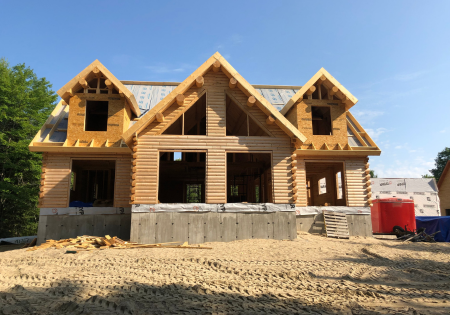
The short answer is that most homeowners can expect 8 to 14 months from project kickoff. From the day your log home package is delivered to the day you move in, a typical build will take about 5 to 9 months. This depends on your site, season, design choices, and how quickly decisions are made.
Here’s how the timeline usually plays out, step by step.
Planning and Design
Roughly Plan on 1 to 3 months
This is where you choose a log home floor plan, customize it to fit your needs/wants, and lock in the big-picture decisions. If you want tips on avoiding decision overload, this post helps: Avoiding Decision Fatigue When Choosing Finishes.
What helps:
- Don’t just start with square footage; start with how you live
- Make a short list of must-haves and wants
- Decide early on the exterior look, the kitchen layout, and the number of bathrooms
Permits, bids, and ordering
Roughly plan on 1 to 2 months
Your town or county will need to review the plans. Your log home builder will finalize bids and schedule the crew. Ward Cedar Log Homes will firm up drawings and coordinate delivery. Some locations are faster, while others take longer.
What helps:
- Ask your code office what permits you need and how long approvals take
- Choose a builder early in the process
- Order long-lead items sooner rather than later
Site Prep and Foundation
Roughly plan on 2 to 6 weeks
Clearing, driveway, excavations, and foundation work set the stage. Weather and soil conditions matter here. A simple, level site moves faster than a steep or remote one.
What helps:
- Walk the land with your builder before digging
- Plan drainage and access early on
- Keep the site clean and ready for deliveries
Delivery Day and Shell Assembly
Roughly plan on 4 to 7 weeks to get your log home dried-in. Also referred to as weather-tight.
Your pre-cut and numbered log home package arrives, and the home starts going up. Walls, roof system, windows, and exterior doors get you a weather-tight shell so trades can work inside. Crew size, weather, and design complexity play a role.
What helps:
- Make sure there is clear truck access and staging space
- Have a single point of contact for questions
- Confirm inspections ahead of time so nothing waits on paperwork
Curious what’s in a log home kit and what’s not? Try: What is a log Cabin Kit?
Mechanical rough-ins
Roughly plan on 3 to 6 weeks
Electricians, plumbers, and HVAC contractors run lines and set equipment. Then the roof insulation goes in. Cedar’s natural insulation value already helps, and good windows and air sealing make it even better.
What helps:
- Finalize fixture and appliance choices early
- Walk the rooms and confirm outlet and switch placements
- Keep decisions moving along so trades do not stall
Interior Finishes
Plan on 8 to 12 weeks
Your cabinets, countertops, flooring, interior doors, and trim start bringing your log home to life. Lead times for finishes can extend schedules, so ordering early is key.
What helps:
- Approve samples before they are ordered
- Use a simple approvals checklist with dates
- Be available for quick questions
Final details, inspections, and move-in
Roughly plan 2 to 4 weeks
Paint touch-ups, fixture installation, final inspections, and a walk-through with your builder to wrap things up. Then it is keys in hand.
What helps:
- Keep a short punch-list and review it weekly
- Schedule utility turn-on ahead of time
- Plan your move date with a little buffer
The Takeaway
Plan on about 8 to 14 months for the full log home journey, with about 5 to 9 months from delivery to move-in ready. The more you decide up front and the more communication, the smoother it goes.
If you are just starting to explore your options, we recommend downloading the Getting Started Guide – The Ward Way or checking out some of our most popular floor plans to see what speaks to you.
Be sure to follow us on Facebook, Pinterest, and Instagram for inspiration, events, tips and more!